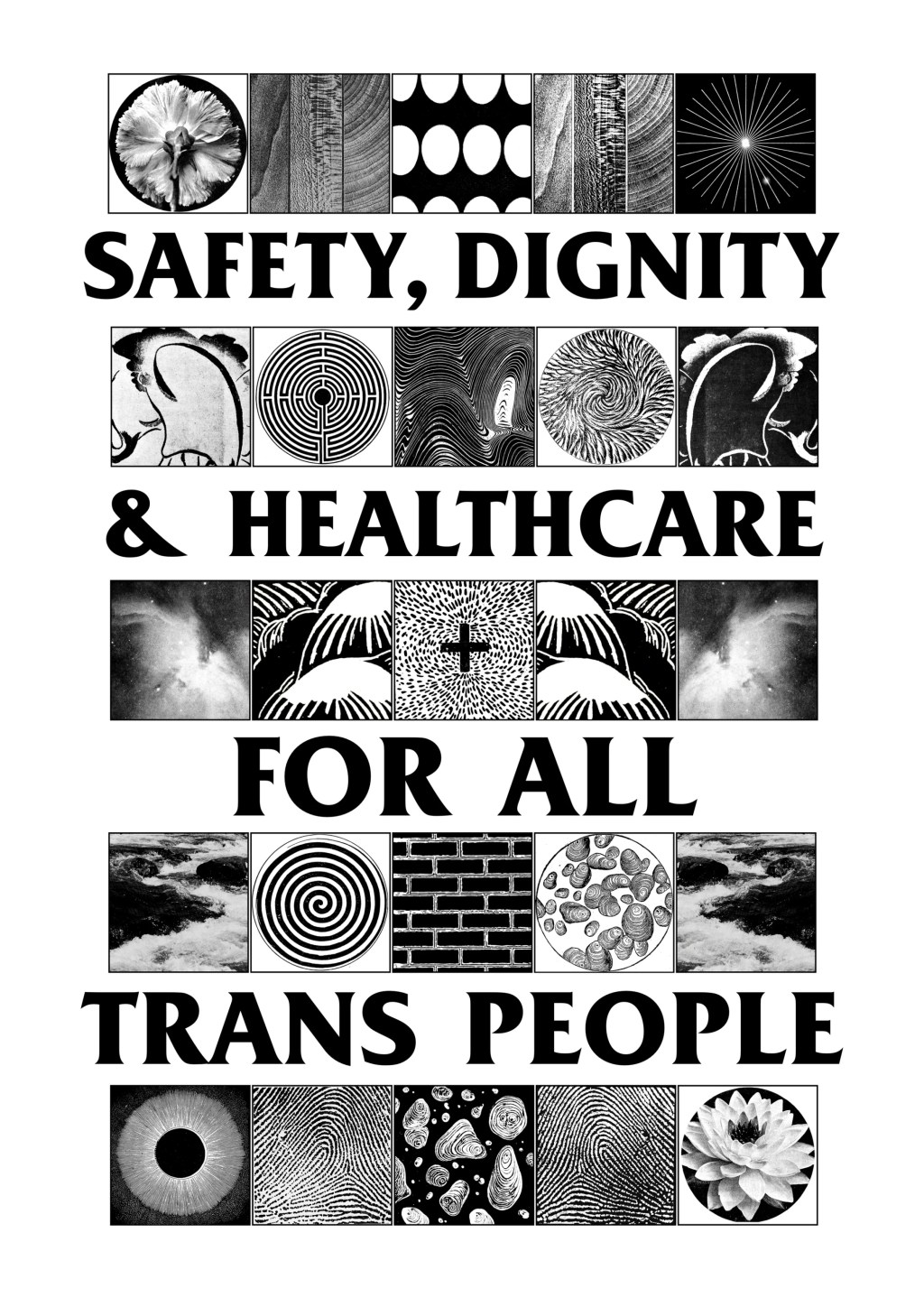
Source: Black Lodge Press
If you are a trans person in the UK right now, you are seen as less-than-human. Countering any ideal of heteronormative sex, gender and sexuality is one of many ways trans people are castigated from the ‘normal’, or made less-than-human. One location of this othering, in the construction of the less-than-human, that I want to (maybe not effectively) focus on is the liberal conception of rationality[1].
Rationality, a striving for the absence of emotions—to be absent from anger, passion, frustration—in the face of blatant hypocrisy and lack of context, is cherished more than ever as a powerful suppressor of emotions within social structures. Black women’s experiences of misogynoir is a clear example—if a Black woman is outspoken about institutional racism, she is depicted as angry and silenced through rationality[2]. As a concept, it is heavily located in colonial and patriarchal histories, bringing civility to the so-called ‘uncivilised’ as a justification of the rape and pillaging of cultures, local resources, and bodies. Rationality, as a deeply liberal-capitalist project, delineates the expectations of any actor in a given situation, no matter the context – here context (historical, material, institutional) is suffocated.
More and more, trans people have been the subject of a similar gaslighting by liberal-capitalist rationality. Institutional UK Politics strives on the hegemonic battle for the one who is more liberally ‘rational’, who seeks peace and fact, who embraces debate for debate’s sake despite, and often in contra to, context.
Brianna Ghey and her murder has become a symbol for the struggle for trans existence. But trans existence has also become a ‘moral panic’, whipped up by those jostling over each other with clammy hands to get closer to Power. Rishi Sunak and his party sees it politically valuable, morally justifiable, to literally make trans people a laughing stock[3]. Their augmented and constructed attack lines, they feel, helps them manufacture some political power, narrative, and ultimately ‘relevance’[4]. Their intimate intertwining with the most economically powerful people in our society helps spread their hateful rhetoric to manufacture a general election based on issues of rights over bodies, dismissing the countless paths of destruction they have created, and the atomisation, in all parts of society[5]. Rationality is hailed in the fight for power—it is rational and necessary to stoke these flames, for the good of the party, for a closer stretch with a clammy hand to Power.
Keir Starmer and his party wants to segregate trans people in hospitals from, I guess, ‘normal’ people (?), and continue to harbour outspoken transphobes within the Labour party. This is because it is politically viable to not ‘cause controversy’—rise in hate crimes against trans people, the UK reputation abroad as seething with transphobia, are obviously things he considers uncontroversial. He would love nothing more than rubbing up against the most economically powerful people in our society, and his silence is politically viable whilst right-wing media channels continue to pedal transphobic narratives on a daily basis. This, of course, is until it becomes politically viable to then ‘speak’ about trans issues, whereby Starmer is somehow shockingly hailed as a progressive standing defiantly against hate[6]. He has been labelled as ‘hitting back’ or confronting Sunak with ‘anger’, as media institutions proclaim that Starmer is allowed to be emotional under the guise of rationality.
Rationality is power. Rationality is ‘factual’. Rationality is ‘right’. On the inverse, irrationality deals in fiction. Irrationality deals in ‘wrongs’. Irrationality is absurd. It is this blunt and brutal duality that laughs in the face of trans people.
Kemi Badenoch wrote two tweets claiming that Starmer trivialised Brianna Ghey’s murder for political point-scoring. In the same tweet, she wrote “It was shameful of Starmer to link his own inability to be clear on the matter of sex and gender directly to her grief”, stating later in the thread that “Starmer’s behaviour today shows Labour are happy to weaponise this issue when it suits them”[7].
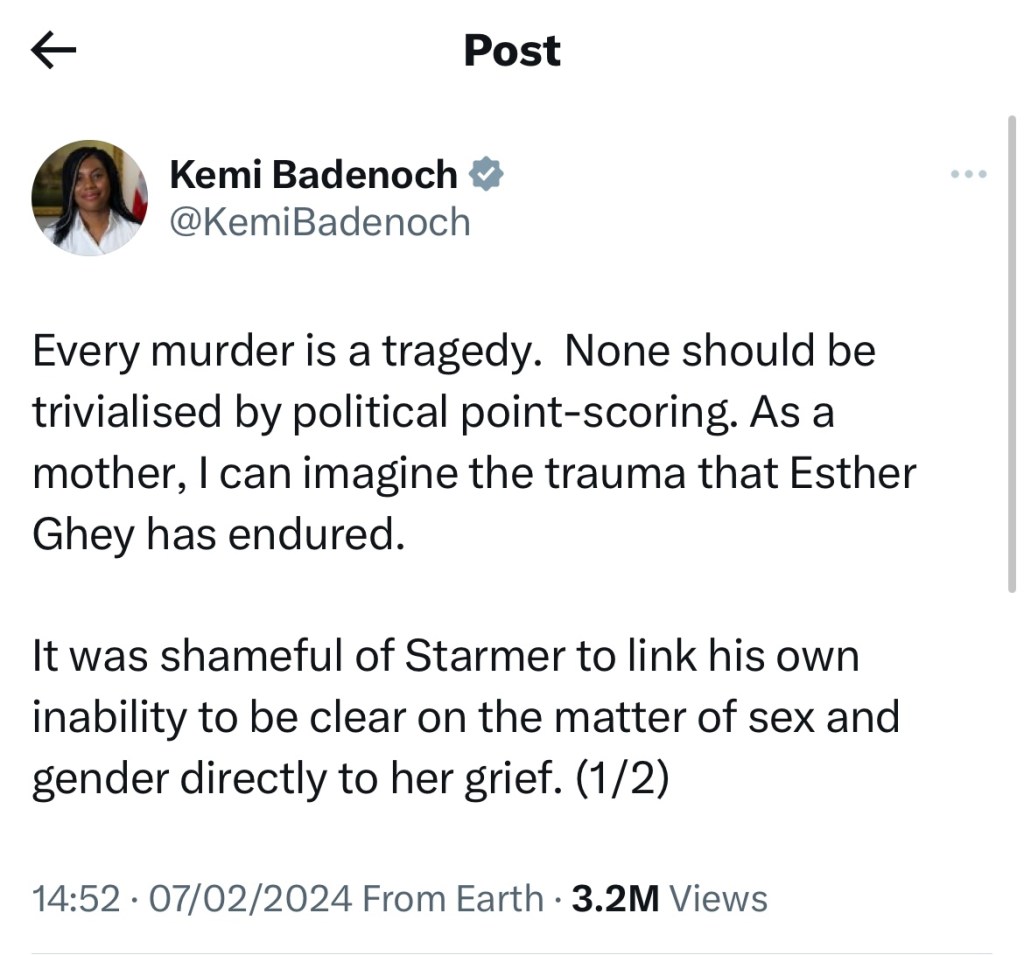
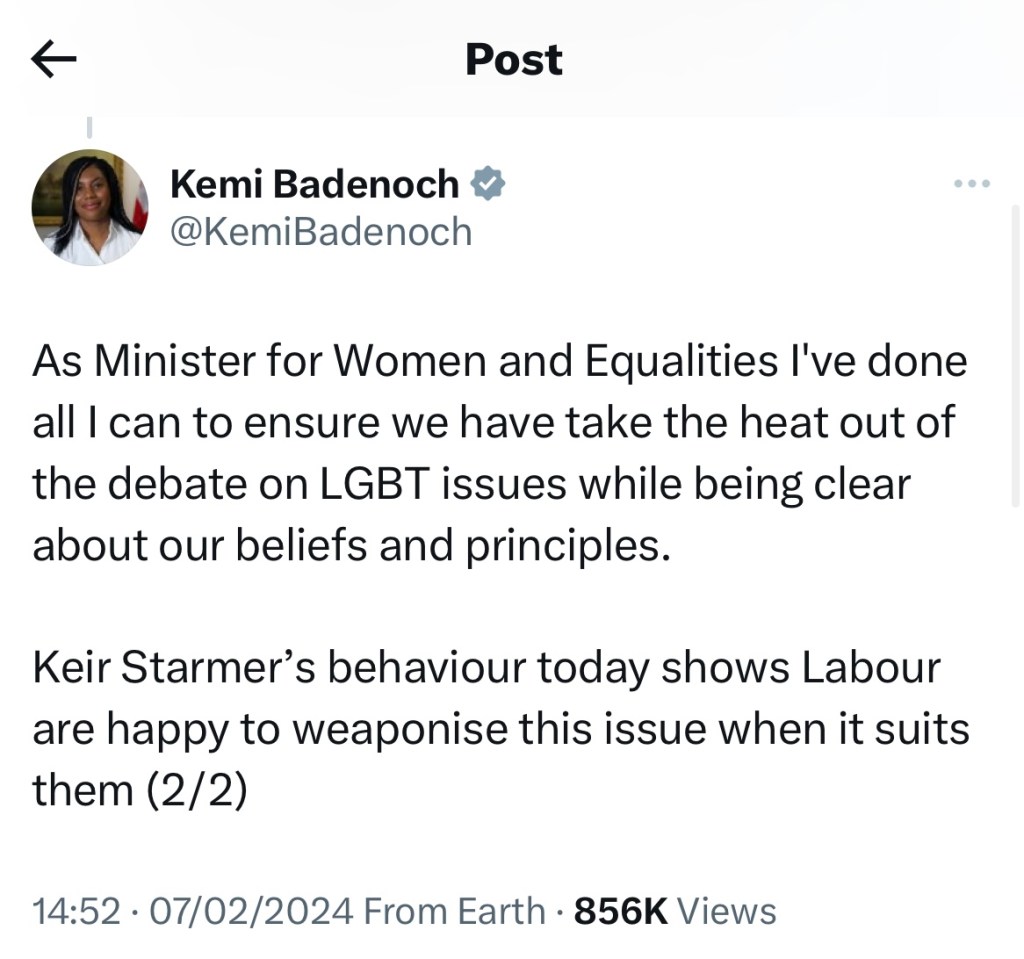
Badenoch employs rationality as a means through which to denounce and belittle Starmer’s argument. She paints him as irrational because of his inability to state what a woman is, irrational for being emotional on the subject, irrational in being unable to contain emotions and employ rational deliberation. Rationality is employed as the truly ‘factual’: Badenoch is the source of the argument, the real set of events, the truly rational in this debate. But employing rationality stinks of incomprehensible hypocrisy, demonstrated and distilled into her single tweet. Badenoch has consistently acted against trans education, healthcare, and support in the hopes of scoring political points: acting against bans on trans conversion therapy, installing hostile environments for trans young people in schools, and fuelling debates about trans existences whilst labelling herself as a supporter of LGBT rights. The context does not matter though, for Badenoch has employed rationality. The full stop. The end of the discussion.
Wes Streeting tweeted his distain for Sunak using “the suffering of others” as a “punchline”[8]. Streeting sought it necessary to stand up for trans people against the hatred from the Tory party. In the face of suffering, Streeting is the rational one to stand against hate, embracing care and support and reason. With an absence of context, he appears sensible and powerful, performing the role of the saviour. And yet Streeting’s words are dripping in hypocrisy. Only weeks ago, he called for a segregation of trans people from non-trans people in hospitals[9]. Segregation and separation creates an Other and draws a line from those deemed ‘normal’ and those as ‘abnormal’. The exclusion of the Other from the (now invented) norm does nothing to tackle hatred and suffering, something Streeting is apparently so concerned about, rather it cements division and allows hatred to fester. But Wes Streeting has employed rationality. The full stop. The end of the discussion.
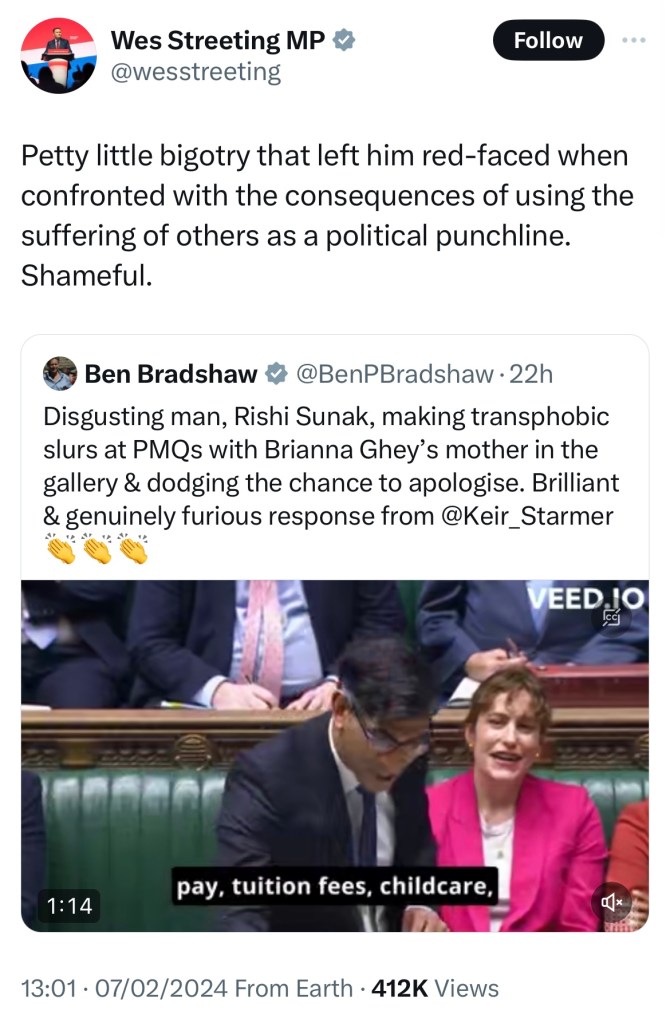
It does not matter that Sunak has brought up the particular attack line around “what is a woman?” in PMQs on multiple occasions, and Starmer is still yet to answer or addressed his transphobia. Only when it is politically viable to demonstrate his rationality, does he then become the saviour and defiant out-speaker.
Fundamentally in these examples of rationality are hypocrisies. In these examples, and possibly more, to be rational is to denounce context. The Political sphere fights for hegemony over rationality, all the while (mis)recognising that to do so forces the Other into sub-humanity.
I write this while struggling to tame my own anger at the blatant hypocrisies that liberal rationality presents. The fight for the one who is most rational does nothing but erase and attempt to rewrite the contexts that this ‘debate’ has arisen through, it rewrites who is allowed to be/not be emotional. Those of us angry find ourselves stuck in the void of rationality and hypocrisy. We feel lost in the liminal space between past and present, context and contemporary, fact and fiction, emotion and rationality. Attempts to call out hypocrisies and contexts makes you irrational, because rationality has been built upon peace and silence, not emotions or context. Liberal rationality constructs the human as so many things including (but not limited to) devoid of emotion[10]: to be emotional is to be less than human.
Stuck in the liminal space observing those employing rationality and by doing so employing hypocrisies frustrates me—I could say to embrace inhumanity, embrace the liminal space. But doing so falls somewhat short right now, and I can only suggest that rationality needs to be destroyed. Destruction happens in radical collective care, in support networks, communal-self-sustainability, and direct action. Find local support networks, practice mutual aid—and if they are not there, build them yourself. Most of all though, take care. Liberation will not happen without you.
Fuck the Tory Party, fuck the Labour Party. Trans liberation forever.
[1] Specifically, rationality in an emotional sense. I don’t necessarily care about rationality in methodically calculating the most efficient outcome. I mean rational = unemotional, level-headed, clear-minded, free from emotion, free of bias, which has been discussed at length by many in much better ways than me.
[2] Audre Lorde and bell hooks are the two most prominent thinkers that discuss this. See bell hooks’ (1981) Ain’t I A Woman, and Audre Lorde’s (1981) The Uses of Anger: Women Responding to Racism
[3] Sunak has, on more than one occasion, used the topic of questioning “what is a woman?” as leverage in the House of Commons for rallying support from the backbenchers behind him
[4] See Chomsky’s (1988) Manufacturing Consent
[5] We can look to Foucault’s biopolitics for one explanation as to why policing and dominating bodies becomes so important from a political and statist standpoint.
[6] See BBC, Guardian, Sky News coverage of Starmer during PMQs: (BBC) https://www.bbc.co.uk/news/uk-politics-68229785 (Sky News) https://news.sky.com/story/brianna-gheys-father-demands-apology-from-pm-after-trans-jibe-in-commons-13066231(Guardian) https://www.theguardian.com/politics/2024/feb/07/rishi-sunak-condemned-pmqs-trans-rights-jibe-brianna-ghey-mother-present
[7] Kemi Badenoch’s tweets: https://x.com/KemiBadenoch/status/1755243156218482780
[8] Wes Streeting’s tweet: https://x.com/wesstreeting/status/1755215198028218645
[9] See the statement by TransActual on the subject of Streeting’s comments for trans people’s segregation in healthcare: http://transactual.org.uk/blog/2024/01/30/statement-on-wes-streetings-comments-about-trans-specific-hospital-wards/
[10] Certain kinds of emotions, of course. As well as certain kinds of bodies that are allowed to be more emotional than others, and yet still those bodies are more often than not the ones deemed Human
 imaginaries
Leave a comment